
How does the NFL work? American football basics for UK viewers
A three-hour NFL broadcast contains, by some genuinely surprising research, only about eleven minutes where the ball is actually in play. The rest is huddles, replays, and the clock ticking down between snaps. It sounds like a knock against the sport — it's really the key to understanding why it's built the way it is.
Why the clock barely runs
The game clock stops constantly: every incomplete pass, every time a ball carrier steps out of bounds, every score, every review. That's the real reason a 60-minute game stretches comfortably past three hours of broadcast — not padding for its own sake, but a sport where almost every play resets the clock and gives both sides time to reset their plan too.
How scoring works
A touchdown — getting the ball into the opposition's end zone — is worth six points, followed immediately by a bonus attempt worth either one point (a straightforward kicked extra point) or two (a run or pass converted from close range). A field goal, kicked cleanly through the posts, is worth three points. A safety — tackling an opponent in their own end zone — is worth two, and is fairly rare.
Downs: the system behind every play
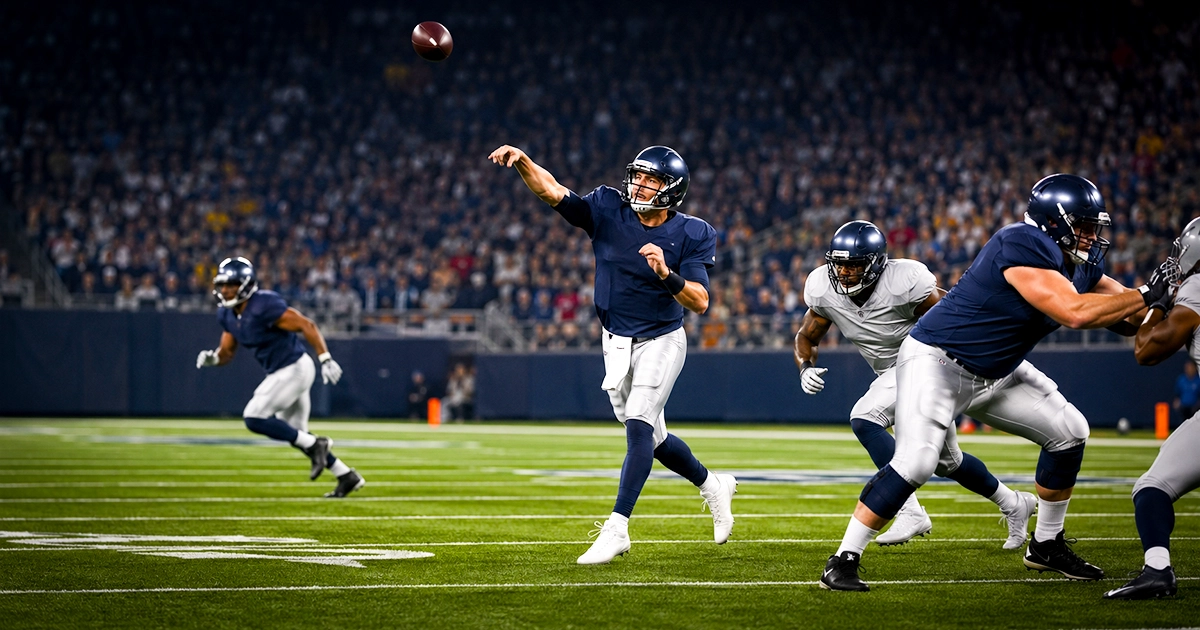
Possession runs on a system of downs: an offence gets four attempts to advance the ball ten yards. Succeed within those four downs, and the count resets with a fresh set of four; fail, and the ball usually changes hands via a punt — a deliberate kick away, typically on fourth down when a team doesn't fancy its chances of converting.
Nearly every strategic decision in the sport traces back to this system — whether to risk going for it on fourth down, when to run versus pass, even how conservatively to play with a lead, all come down to managing four-down cycles rather than a continuous flow of play.
The positions that matter most
On offence:
On defence, the defensive line tries to rush the passer and stop the run at source; linebackers sit just behind them, versatile enough to defend against both the run and the pass; and defensive backs — cornerbacks and safeties — cover receivers and guard against big plays downfield.
Two words that change momentum instantly
An interception is a defender catching a pass meant for the opposition, taking possession outright. A fumble is the ball carrier losing control of the ball, which either team can then recover.
Why it matters so much: a turnover hands the opponent the ball, often in good field position, without them earning it through four downs of their own. That's exactly why commentators treat them as genuine game-swinging moments rather than routine incidents — they short-circuit the whole down system this sport is built around.
From September to February: the road to the Super Bowl
The 17-game regular season is comparatively short, split between the American Football Conference (AFC) and National Football Conference (NFC), each further divided into four smaller divisions. Division winners, plus a handful of the best remaining teams as wildcards, qualify for a single-elimination play-off — lose once and the season's over. Whoever tops each conference goes through to the Super Bowl each February, the single biggest event on the American sporting calendar.
Never miss a game — follow every NFL fixture on Watchsport
Open Watchsport →If basketball's more your thing — or you want to make sense of the NBA too — we've got a beginner's guide to that as well.