
How does the NBA work? Basketball basics for UK viewers
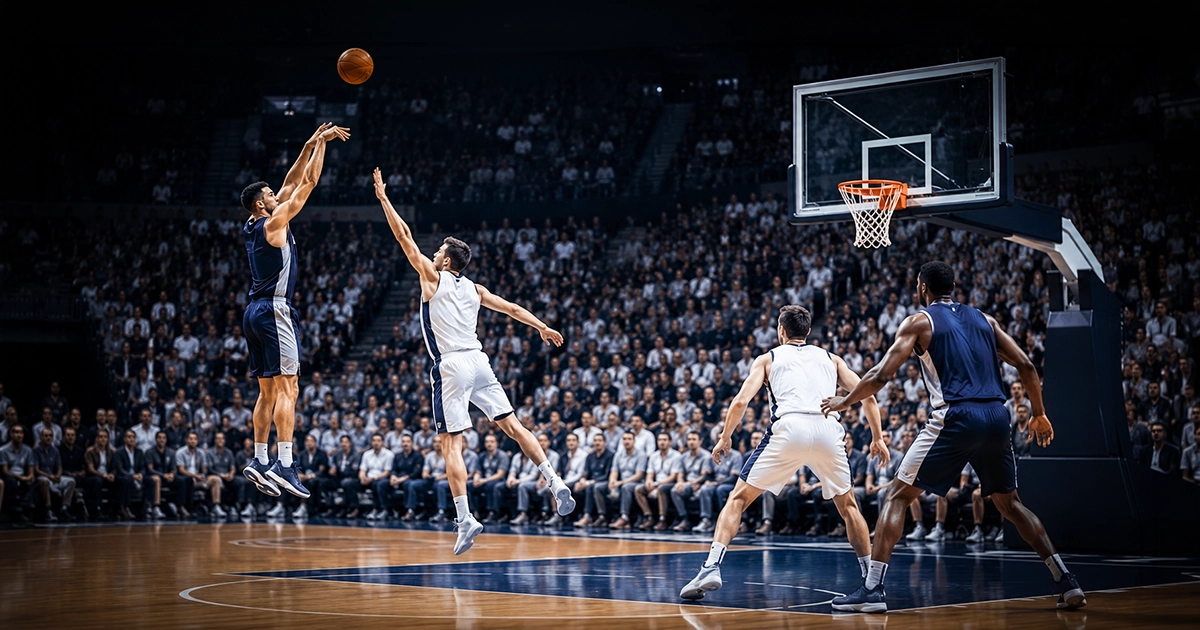
A player picks the ball up thirty feet from the basket, well outside the range most sports would even attempt a shot from, and simply lets it go. Nine times out of ten in most other sports, that's a wasted attempt. In the NBA, it's often the smart play — and understanding why is most of what you need to start following the sport properly.
Why the three-point line changes everything
A basket from inside the arc is worth two points; from beyond it, three. Free throws — awarded after certain fouls — are worth one point each, shot uncontested from a fixed line. That extra point from distance is why teams now deliberately hunt three-point attempts rather than settle for an easier shot just inside the line — the maths simply favours it, even accounting for the lower success rate.
Why this matters on screen: it's the single biggest reason the modern NBA looks so different to basketball from twenty years ago. Teams that once built their whole game around getting the ball close to the basket now happily fire from well beyond it, because three points from 35% of attempts beats two points from 50%.
The shot clock sets the pace
NBA games run four 12-minute quarters — 48 minutes of game time, though broadcasts regularly stretch past two hours once fouls, timeouts, and substitutions are added in. The defining rule is the shot clock: a team has just 24 seconds from gaining possession to get a shot away that at least hits the rim, or the ball goes straight to the opposition.
There's no equivalent to running the clock down in the NBA the way there is in some other sports — 24 seconds simply isn't long enough to stall, which is why the game never really slows down.
Five players, five jobs on court
Each position traditionally carries a defined job, even though the modern game blurs the lines between them more than it used to.
You'll hear commentators use all five labels constantly — even for the growing number of players in today's "positionless" NBA who don't fit neatly into just one of them.
The vocabulary that comes up constantly
A personal foul covers most illegal contact. A turnover is any loss of possession without a shot going up — a bad pass, a shot clock violation, stepping out of bounds mid-dribble. A fast break is a rapid transition from defence to attack before the opposition can set up, usually finishing in an easy basket.
Fouling out: six personal fouls in a game and a player is done for the rest of it. Worth watching for late in close games, when teams sometimes deliberately go after an opponent who's already picked up five.
Getting to a champion: October to June
The regular season runs 82 games, split across an Eastern and a Western Conference. The top teams from each qualify for the play-offs, with a play-in tournament deciding the final couple of spots, then four rounds of best-of-seven series — first to four wins goes through. The two conference champions meet in the NBA Finals each June, again best-of-seven, to settle the season.
Never miss a game — follow every NBA fixture on Watchsport
Open Watchsport →If the NFL is more your thing — or you want to make sense of American football too — we've got a beginner's guide to that as well.