
What is VAR and how does it work?
Every World Cup, it's the same story — a goal goes in, the celebrations start, and then everyone waits for the referee to put a hand to their ear. Here's what VAR is actually allowed to check, and why the on-field referee always has the final say.
What does VAR actually check?
VAR — the Video Assistant Referee — isn't watching the whole match looking for things to overturn. It only steps in for four types of "clear and obvious error":
Everything else — a throw-in given the wrong way, a foul the ref genuinely just missed that isn't one of the four categories above — stays with the referee's judgement on the pitch, same as it always has.
How does the review process work?
A team of officials watches every match from a video operations room, separate from the stadium. For most incidents, they run a silent check in the background and only speak to the referee if they spot something worth a second look.
Example: A striker scores, but the VAR team spots the ball clipped an attacker's arm two passes earlier. The referee is told to review the footage, and either confirms the goal or chalks it off — the decision is still theirs to make.
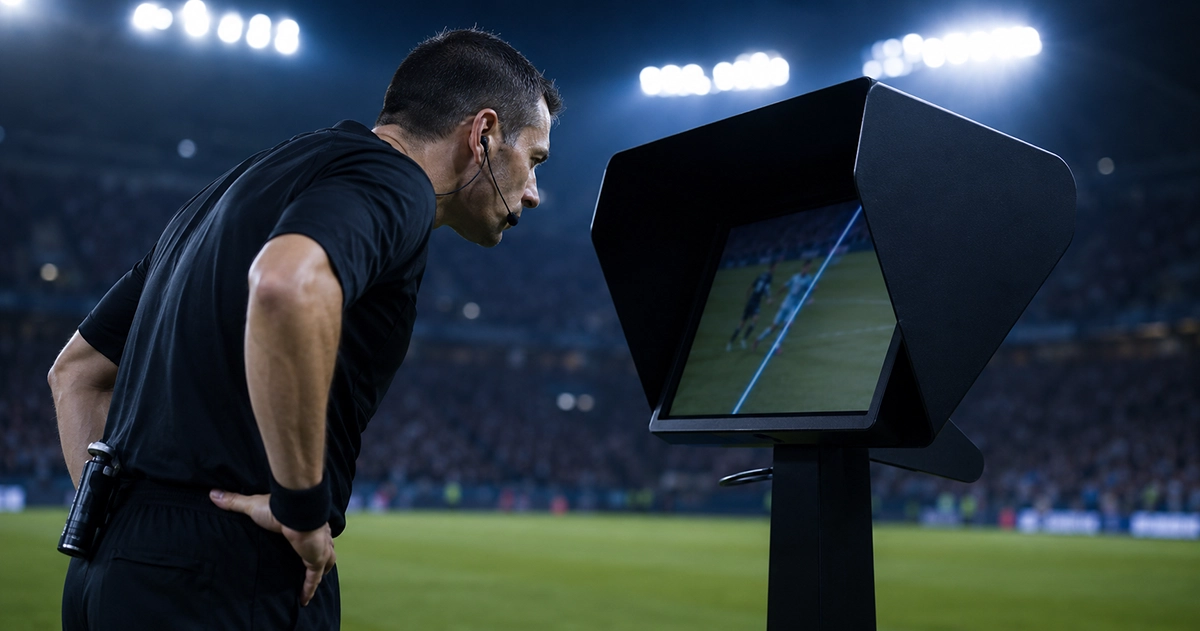
For bigger calls, like a potential penalty, the referee can be sent to a pitchside monitor to watch the replay themselves before deciding. VAR presents the evidence; it never makes the decision.
The key principle is that VAR only overturns clear and obvious errors. If it's a close call that could genuinely go either way, the on-field decision stands — VAR isn't there to referee the match from a monitor.
What about semi-automated offside?
Tight offside calls used to mean a VAR official manually drawing lines across a paused frame — slow, and only as accurate as the camera angle available. Semi-automated technology speeds this up by tracking up to 29 data points on every player, dozens of times a second, using a network of cameras around the stadium plus a sensor inside the ball itself.
The system builds a 3D model of the pitch in real time and can flag an offside position within seconds, which the VAR team then checks before informing the referee. It's faster and more consistent than the old method, but it's still built on human-defined rules — someone still has to decide which body part counts, and that's where the debate usually starts again.
Why VAR still divides opinion
Even with clear categories, offside lines and handball calls still involve a fair bit of judgement — which is exactly why fans, pundits, and players rarely agree on a review. The technology can tell you exactly where a boot was; it can't tell you whether a handball was deliberate. That grey area is where most of the arguments start, and it's unlikely to disappear any time soon.
Never miss a big VAR moment — follow every match on Watchsport
Open Watchsport →