
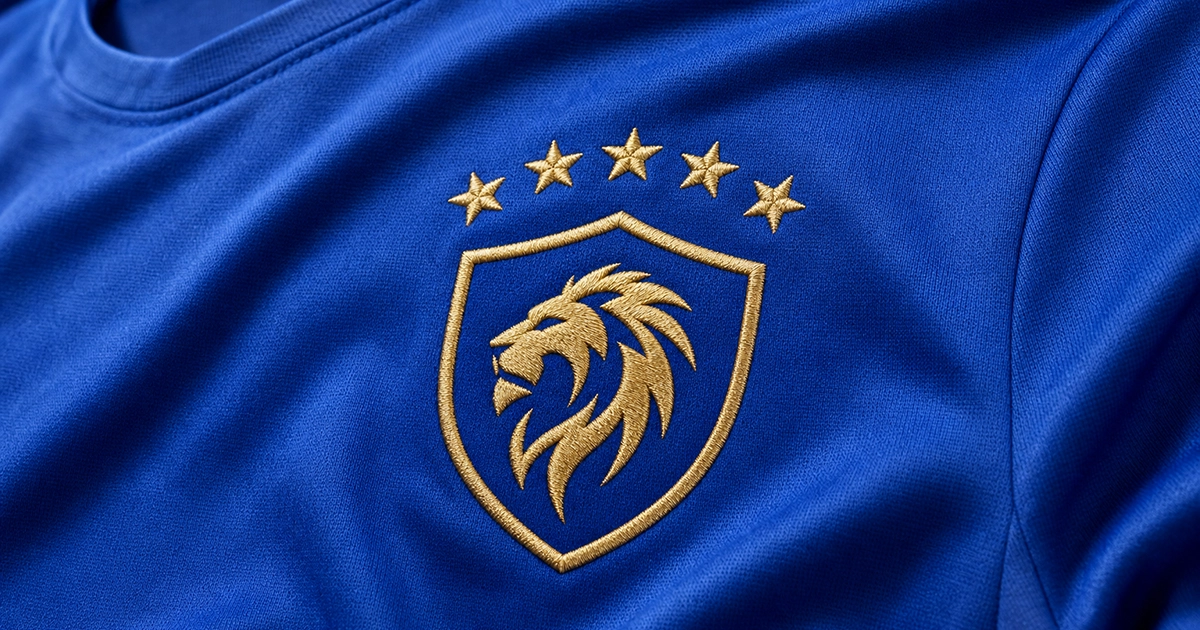
What Do the Stars on Football Shirts Actually Mean?
A star above a badge, a ball made entirely of stars, a number stitched inside a sleeve patch — football throws stars at you from every angle, and they almost never mean the same thing twice. Here's what's actually going on with each one.
Three different habits, one confusing sport
Strip it back and there are really three separate traditions at work, and football commentators aren't always great at telling you which one they're talking about. There's the Champions League's own branding, which has nothing to do with any individual club. There's the star (or stars) a club sews above its own crest, which is entirely about that club's history. And there's a much rarer UEFA award that only a handful of clubs in the world have ever qualified for. Confuse any two of them and you'll end up wildly wrong about what a shirt is telling you.
The ball itself: eight stars, eight clubs
Start with the most famous one — the “starball” that's been the Champions League's logo since UEFA rebranded the old European Cup in 1992. It was designed by Phil Clements at the London agency Design Bridge, and the brief was oddly specific: UEFA wanted something built around the clubs taking part. Clements drew them as stars, and stopped there rather than cluttering the sketch with anything else.
There are eight of them, and that number isn't decorative — it's a direct nod to the eight clubs who contested the very first Champions League group stage in 1992/93: Rangers, Marseille, AC Milan, IFK Göteborg, Club Brugge, Porto, CSKA Moscow and PSV Eindhoven. Scottish football fans have a genuine claim on this one — Rangers were there at the start, in the same group stage that gave the badge its shape.
What's stitched above the badge
This is the one that trips people up most, because it looks similar but means something completely different: a star (or stars) a club adds above its own crest, entirely independent of Europe. The number represents league titles, and how many titles per star varies by country.
Closer to home, it's a genuinely interesting split. Celtic wear a single star — not for a league title at all, but for becoming the first British club to win the European Cup, in Lisbon in 1967. Rangers wear five, representing their record haul of domestic league titles, unrelated to any European success. It's a small but real illustration of how differently two clubs from the same city can choose to wear their history — something we've covered in more depth in our piece on the Old Firm and where the rivalry actually comes from.
Italy runs its own version of the same idea: one gold star for every ten Serie A titles won. Juventus, Italian football's most successful club by some distance, have worn three stars since 2014, when they passed the 30-title mark. Their tally has grown since — 36 as of the 2025/26 season — but a fourth star isn't due until they reach 40.
Rule of thumb: if the star sits directly above a club's own badge, it's about that club's trophy cabinet — not Europe, and not any single competition. Always check what the club themselves say it represents, since the convention isn't identical from country to country.
The number tucked inside the starball
The rarest of the three is UEFA's own “multiple-winner badge”, sometimes called the badge of honour, worn on the sleeve. It's only awarded to a club that has won the European Cup or Champions League either five times outright or three times in a row, with the club's total etched into the centre of the badge. It dates back to a rule that once let a club keep the actual physical trophy permanently on reaching that milestone — a prize only ever handed out a handful of times before UEFA took the real trophy out of circulation for good in 2009.
Only a handful of clubs have ever qualified: Real Madrid, AC Milan, Bayern Munich, Ajax, Liverpool and Barcelona among them. It's a genuinely exclusive club, and worth watching for the next time European giants line up in the tunnel — that small number on the sleeve tells you more about a club's history than the shirt itself usually lets on.
Spot the difference next time
Three genuinely different stories, all told in the same shorthand. Next time you see a star on a shirt, the quickest way to work out which one you're looking at is to ask where it's sitting: on the ball itself, it's the Champions League's own branding; above the badge, it's the club's own trophy count; tucked inside a sleeve patch with a number in the middle, it's the rarest of the three — UEFA's own seal of approval.
Every European night, every kick-off time, one place — no more juggling apps to find who's showing what
Open Watchsport →